---
title: 15 Recording Sessions With the European Recording Orchestra | FSAE
description: Capture the Essence of Your Compositions through 15 Recording Sessions with the European Recording Orchestra (ERO).
image: https://www.eafa.iamu.edu/hubfs/student%20conducting.jpg
---
[](https://www.eafa.iamu.edu/?hsLang=en)
- Masters
Masters
- [MFA in Film and Game Scoring](https://www.eafa.iamu.edu/filmscoringacademyofeurope/master-fine-arts-film-and-game-scoring)
- [MFA in Conducting](https://www.eafa.iamu.edu/theconductinginstitute/master-fine-arts-conducting-classical-studio-contemporary)
- Online
Online
- [Online Graduate Diploma in Film & Game Scoring](https://www.eafa.iamu.edu/filmscoringacademyofeurope/online-graduate-diploma-film-and-game-scoring)
- Summer
Summer
- [Film Scoring Summer Programme](https://www.eafa.iamu.edu/filmscoringacademyofeurope/film-scoring-summer-program)
- [Conducting Summer Programme](https://www.eafa.iamu.edu/theconductinginstitute/conducting-summer-program)
- Faculty
Faculty
- [EAFA Administration and Creative Team](https://www.eafa.iamu.edu/administration-and-creative-team)
- [Film Scoring Academy of Europe](https://www.eafa.iamu.edu/filmscoringacademyofeurope/faculty)
- [The Conducting Institute](https://www.eafa.iamu.edu/theconductinginstitute/faculty)
- Resources
Resources
- [Alumni](https://www.eafa.iamu.edu/filmscoringacademyofeurope/alumni-access)
- [Blog](https://www.eafa.iamu.edu/european-academy-of-fine-arts-resources-hub)
- [Call for Scores](https://www.europeanrecordingorchestra.com/win-a-session)
- [FAQ](https://www.eafa.iamu.edu/frequently-asked-questions)
- Get Started
Get Started
- [Apply Now](https://www.eafa.iamu.edu/apply)
- [Request Info](https://www.eafa.iamu.edu/general-enquiries)
[](https://www.eafa.iamu.edu/?hsLang=en)
- Masters
Masters
- [MFA in Film and Game Scoring](https://www.eafa.iamu.edu/filmscoringacademyofeurope/master-fine-arts-film-and-game-scoring)
- [MFA in Conducting](https://www.eafa.iamu.edu/theconductinginstitute/master-fine-arts-conducting-classical-studio-contemporary)
- Online
Online
- [Online Graduate Diploma in Film & Game Scoring](https://www.eafa.iamu.edu/filmscoringacademyofeurope/online-graduate-diploma-film-and-game-scoring)
- Summer
Summer
- [Film Scoring Summer Programme](https://www.eafa.iamu.edu/filmscoringacademyofeurope/film-scoring-summer-program)
- [Conducting Summer Programme](https://www.eafa.iamu.edu/theconductinginstitute/conducting-summer-program)
- Faculty
Faculty
- [EAFA Administration and Creative Team](https://www.eafa.iamu.edu/administration-and-creative-team)
- [Film Scoring Academy of Europe](https://www.eafa.iamu.edu/filmscoringacademyofeurope/faculty)
- [The Conducting Institute](https://www.eafa.iamu.edu/theconductinginstitute/faculty)
- Resources
Resources
- [Alumni](https://www.eafa.iamu.edu/filmscoringacademyofeurope/alumni-access)
- [Blog](https://www.eafa.iamu.edu/european-academy-of-fine-arts-resources-hub)
- [Call for Scores](https://www.europeanrecordingorchestra.com/win-a-session)
- [FAQ](https://www.eafa.iamu.edu/frequently-asked-questions)
- Get Started
Get Started
- [Apply Now](https://www.eafa.iamu.edu/apply)
- [Request Info](https://www.eafa.iamu.edu/general-enquiries)
[](https://www.eafa.iamu.edu/?hsLang=en)
- Masters
Masters
- [MFA in Film and Game Scoring](https://www.eafa.iamu.edu/filmscoringacademyofeurope/master-fine-arts-film-and-game-scoring)
- [MFA in Conducting](https://www.eafa.iamu.edu/theconductinginstitute/master-fine-arts-conducting-classical-studio-contemporary)
- Online
Online
- [Online Graduate Diploma in Film & Game Scoring](https://www.eafa.iamu.edu/filmscoringacademyofeurope/online-graduate-diploma-film-and-game-scoring)
- Summer
Summer
- [Film Scoring Summer Programme](https://www.eafa.iamu.edu/filmscoringacademyofeurope/film-scoring-summer-program)
- [Conducting Summer Programme](https://www.eafa.iamu.edu/theconductinginstitute/conducting-summer-program)
- Faculty
Faculty
- [EAFA Administration and Creative Team](https://www.eafa.iamu.edu/administration-and-creative-team)
- [Film Scoring Academy of Europe](https://www.eafa.iamu.edu/filmscoringacademyofeurope/faculty)
- [The Conducting Institute](https://www.eafa.iamu.edu/theconductinginstitute/faculty)
- Resources
Resources
- [Alumni](https://www.eafa.iamu.edu/filmscoringacademyofeurope/alumni-access)
- [Blog](https://www.eafa.iamu.edu/european-academy-of-fine-arts-resources-hub)
- [Call for Scores](https://www.europeanrecordingorchestra.com/win-a-session)
- [FAQ](https://www.eafa.iamu.edu/frequently-asked-questions)
- Get Started
Get Started
- [Apply Now](https://www.eafa.iamu.edu/apply)
- [Request Info](https://www.eafa.iamu.edu/general-enquiries)
Previous slide
Next slide
# 15 Recording Sessions
Bring your music to life and master the art of writing for live musicians via 15 studio recording sessions of your music with the European Recording Orchestra. This professional ensemble, composed of exceptional musicians from Sofia, Bulgaria, specialises in studio recordings for film, TV, and more. By partnering with them, we provide you with an invaluable opportunity to enrich your portfolio and showcase your musical prowess.
### How do the recording sessions work?
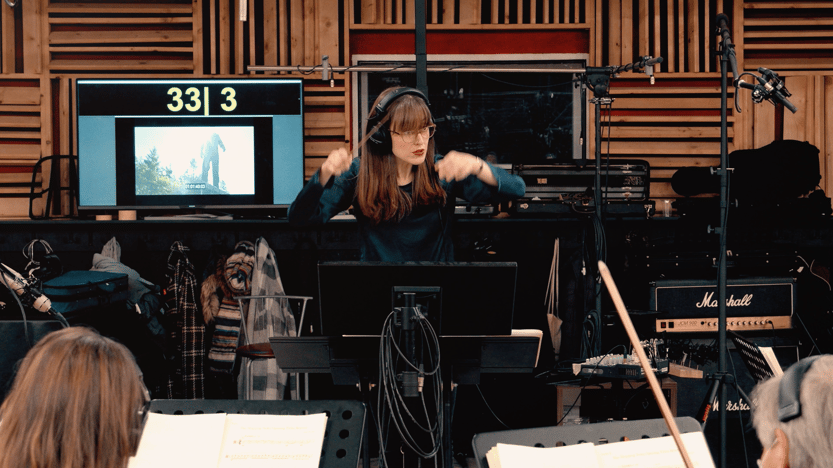
Masters composers participate in the recording process from start to finish. You’ll conceive of your music in the DAW, orchestrate it in Dorico, then score and parts prep everything the same way they do in London or LA. You’ll gain experience serving as librarian, facilitating scores and parts in recording order and distributing them to musicians. When recording time comes, you’ll be in the booth with our faculty and ERO score supervisors and engineers, providing feedback on the way the ensemble is performing your music.
### How much music can you record on a given session?
Throughout the one-year Masters experience, you will be allocated 20-minute recording slots during each session. This time frame allows you to record music up to 2 minutes in length, giving you the chance to bring your compositions to life in a professional setting.
### Why put such a focus on recording sessions?
Our focus on recording sessions extends beyond the obvious portfolio-building benefits. We also equip you with invaluable skills in writing music for studio musicians and effective time management in the studio. Delivering outstanding results in the recording studio with live musicians is the gold standard in music for screen entertainment. By honing these skills, we ensure you're prepared to thrive in the industry and compete at the highest level.
### What will you receive for your portfolio?
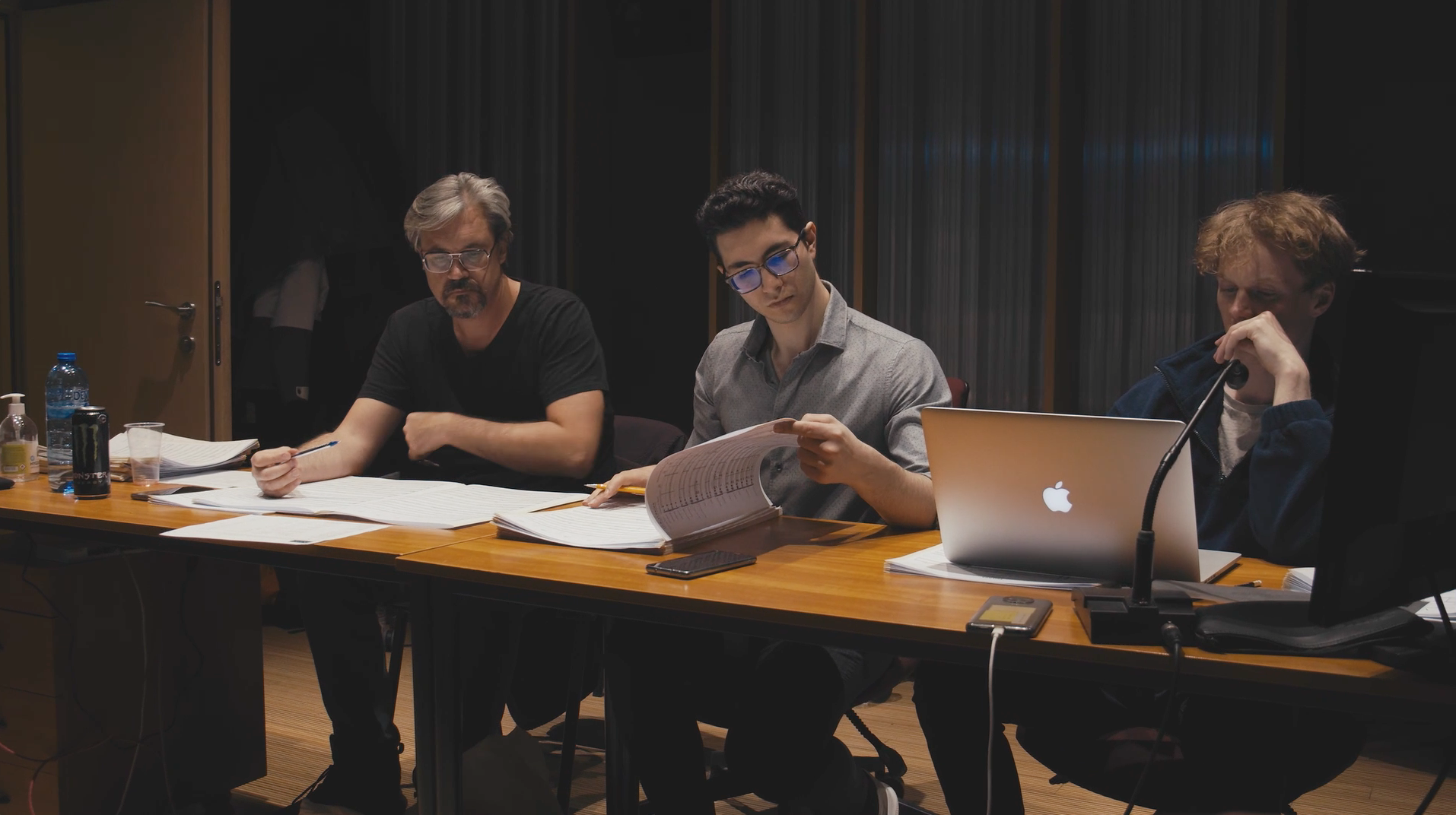
High fidelity audio is not the only thing our composers take away from each session. You will also receive multicam HD videos of your sessions. These videos serve as a visual representation of your music being recorded in the studio, enabling you to create professional videos that capture the essence of the session itself. It's the perfect tool to curate a portfolio that truly represents your unique talent.
### What will you record in each session?
Our recording sessions evolve in step with the demands of the industry. We design our instrumentation lineups around what today’s composers actually need—starting with solo piano and progressing through small ensembles, chamber groups, and game-ready striping setups, all the way to full 52- and 84-piece symphony orchestras. By constantly adapting our ensembles, we ensure you gain hands-on experience with the formats most relevant to scoring for film, TV, and games today.
### **The reason composers choose FSAE**
This is the reason hundreds of composers have chosen FSAE over any other film scoring school in the world.
At FSAE, recording sessions are not a bonus, an occasional opportunity, or a single end-of-year project. They are the foundation of the programme. From the beginning of the year, you are writing for real musicians, preparing professional scores and parts, recording in world-class studio environments, receiving feedback from faculty and industry professionals, and building the kind of portfolio most young composers spend years trying to create after graduation.
There is no other film scoring education in the world built around this level of practical recording experience. Across the year, you compose, orchestrate, record, produce, and mix a major body of work with the **European Recording Orchestra**, moving from intimate solo and chamber sessions to large-scale orchestral, folk, choir, hybrid, and game scoring projects.
By the time you graduate, you will not simply have studied film scoring. You will have done it, again and again, under real professional conditions.
### **Build a portfolio that proves what you can do**
The industry does not hire composers because they say they can write. The industry hires composers when the work proves it.
At FSAE, every recording session is designed to build a different part of your professional portfolio. You begin with the most essential challenge in film music: emotional clarity. Can you communicate one specific human emotion with solo piano? From there, the assignments expand in scale and complexity, moving through chamber music, strings, orchestra, low brass, folk instruments, woodwinds, adaptive game music, love themes, choir, and full symphony orchestra.
This is how FSAE students consistently stand out at major film music festivals, conferences, and international scoring competitions. Year after year, our students are among the strongest participants at events such as the **Film Music Prague Festival**, and FSAE composers have won awards at major international platforms including the **Ghent Film Festival**, **Krakow Film Festival**, **Berlin Film Scoring Competition**, and **Oticons Faculty Film Scoring Competition**.
That success comes from a comprehensive education built around one central truth: composers become professional by doing professional work.
### **What you will record**
Across the year, you will build a serious, diverse, professionally recorded portfolio with the **European Recording Orchestra**. Your work will show range, not repetition. It will prove that you can handle intimacy, drama, action, fantasy, tension, romance, atmosphere, cultural color, hybrid production, interactive systems, and large-scale symphonic writing.
Throughout the programme, you will record music for:
- **Solo piano**, focused on emotional clarity and direct musical communication
- **Piano trio**, translating descriptive scenes into intimate dramatic music
- **22-piece chamber strings**, your first major live-to-picture dramatic scoring session
- **38-piece symphony orchestra**, for a main title or emotional climax
- **Epic low brass and low strings**, recorded in separate orchestral layers
- **Bulgarian folk soloists**, creating a distinctive and culturally rich portfolio piece
- **Eight upright basses**, an extremely rare recording experience built around depth, pressure, weight, and physical power
- **Orchestral woodwinds**, focused on color, restraint, and narrative sensitivity
- **Adaptive game music**, recorded in layers and implemented as a dynamic system in Wwise
- **Large string ensemble with piano, harp, celesta, and vocal overdub**, focused on writing a memorable love theme
- **84-piece symphony orchestra**, the largest ensemble of the programme and a major showpiece portfolio opportunity
- **20-piece choir and 52-piece symphony orchestra**, supporting your final Major Project
### **From intimate emotion to massive orchestral scale**
The year begins with simplicity, because simplicity is where musical truth is tested. Your first session asks you to write a short solo piano piece that communicates one clear emotion. No explanation. No hiding behind production. Just the music, the performer, and the listener.
From there, the programme expands rapidly. You write for piano trio, chamber strings, and then a 38-piece symphony orchestra, learning how to support picture, shape drama, create emotional movement, and write music that comes alive in the hands of real performers.
Then the scale increases. You record epic low brass and low strings in separate ensemble passes, learning how modern orchestral scores are built in layers. You write for **eight upright basses**, including instruments with low C extensions, creating a sound world of gravity, darkness, pressure, and force that no ordinary sample library can truly replicate.
### **A portfolio that does not sound like everyone else’s**
FSAE’s recording sessions go far beyond standard orchestral writing. You will record Bulgarian folk soloists, giving your portfolio a unique color and identity that immediately stands apart from generic demo reels. You will write for orchestral woodwinds, learning subtlety, transparency, register, restraint, and the expressive use of soloistic color.
You will also enter the world of game scoring, composing and implementing an adaptive music system in **Audiokinetic Wwise**. Instead of writing a linear cue, you will design music that responds to gameplay through layers, states, loops, stingers, combat material, and transitions. For composers interested in games, this becomes an essential portfolio piece. For composers focused on film and television, it is still invaluable training in structure, pacing, modularity, and modern production thinking.
And then you write a love theme, one of the most important challenges in all of screen music. With strings, piano, harp, celesta, and a professional female vocal overdub, you create a refined, emotionally direct piece built around melody, intimacy, and the expressive power of the human voice.
### **The biggest sessions of the year**
One of the most extraordinary opportunities in the programme is the **84-piece symphony orchestra** session. This is the largest ensemble of the year and a major showpiece opportunity for your portfolio. You may write a dramatic film scene, a sweeping main theme, a bold standalone cinematic piece, or a major cue designed to fill an important gap in your reel.
An orchestra of this size gives you access to the full dynamic and coloristic spectrum of symphonic writing: chamber-like delicacy, massive full-ensemble power, intricate internal motion, emotional breadth, and cinematic grandeur. For many composers, recording an 84-piece orchestra is a once-in-a-lifetime opportunity. At FSAE, it is part of the curriculum.
The year culminates in the **Major Project**, supported by a **20-piece choir recording session** and a **52-piece symphony orchestra recording session**. This is your final artistic statement: a substantial, independently developed project that reflects your voice, ambition, and professional direction. It brings together everything you have learned: composition, orchestration, recording, production, artistic identity, professional presentation, and portfolio development.
### **Graduate with proof**
By the time you graduate from FSAE, you will have proof.
Proof that you can write for real musicians.
Proof that you can handle a studio environment.
Proof that you can prepare professional scores and parts.
Proof that you can score drama, action, romance, atmosphere, games, and large-scale cinematic moments.
Proof that you can work with orchestra, choir, soloists, chamber ensembles, hybrid production, and interactive systems.
At FSAE, you do not wait for your first real recording opportunity.
You build your career on it.
[Back to MFA Programme](https://www.eafa.iamu.edu/filmscoringacademyofeurope/master-fine-arts-film-and-game-scoring?hsLang=en#recording-sessions)
#### Have questions about this programme?
Speak with our Admissions Department. Submit our enquiry form to receive personalised answers to your questions.
[Request Info](https://www.eafa.iamu.edu/filmscoringacademyofeurope/master-fine-arts-film-and-game-scoring?hsLang=en#request_more_info)
## Additional Information: Master of Fine Arts
Tuition and Fees
**2026-2027 MFA Programme Tuition: €36,950**
**Tuition Schedule**
Programme Deposit: €2,000 (Due Immediately to Enroll)
Tuition Downpayment: €5,000 (Due May 1, 2026)
Payment 1: €11,950 (Due September 1, 2026)
Payment 2: €9,000 (Due December 1, 2026)
Payment 3: €9,000 (Due March 1, 2027)
The MFA programme at the Film Scoring Academy of Europe is the most affordable full-time Masters programme in film & game scoring available today, while simultaneously offering more recording sessions than any other programme in the world, thanks to our partnership with the European Recording Orchestra (ERO).
Be sure to check out the "Costs of Living in Sofia" dropdown to see how much more affordable Sofia is compared to other major European and American cities.
Financial Aid
Students from the United States can take advantage of the FAFSA Federal Student Aid program. For more information, visit [https://studentaid.gov/h/apply-for-aid/fafsa](https://studentaid.gov/h/apply-for-aid/fafsa)
**More Financial Aid Programmes:**
All students searching for scholarships should search this website: [https://www.wemakescholars.com](https://www.wemakescholars.com/)
Norway: Lanekassen - [https://www.lanekassen.no/](https://www.lanekassen.no/)
Colombia: Colfuturo - [https://www.colfuturo.org/](https://www.colfuturo.org/)
South Africa: National Film and Television Foundation (NFVF) - [https://www.nfvf.co.za/home/](https://www.nfvf.co.za/home/)
South Africa: Oppenheimer Trust - [https://www.omt.org.za/](https://www.omt.org.za/)
2026-2027 Academic Calendar
**2026-2027 Academic Calendar**
**Term 1** - Full time, presence in Sofia required
13 September, 2026 - 6 December, 2026
**Term 2** - Remote
11 January, 2027 - 8 March, 2027
**Term 3 -** Full time, presence in Sofia required
10 March, 2027 - 4 June, 2027
**Term 4 -** Remote
7 June, 2027 - 30 August, 2027
Costs of living in Sofia
Sofia offers an excellent quality of life at a comparatively accessible cost, making it an attractive European destination for graduate study.
According to Numbeo’s 2026 Cost of Living Plus Rent Index, Sofia is approximately:
- 66% less expensive than New York City
- 59% less expensive than Boston
- 58% less expensive than London
- 55% less expensive than Los Angeles
- 18% less expensive than Valencia
Students can explore current city comparisons at [Numbeo](https://www.numbeo.com/cost-of-living/comparison.jsp).
A variety of accommodation options are available throughout Sofia, including furnished apartments, shared accommodation, hotels, hostels, and short-term rentals. Prices vary according to location, season, length of stay, and accommodation type.
The Film Scoring Academy of Europe provides students with local guidance and accommodation resources to help them identify options that suit their schedule, preferences, and budget. Students are encouraged to begin exploring accommodation early and may also choose to share with classmates during their time in Sofia.
Technology Requirements
**Technology Requirements:**
- Avid Pro Tools 12
- DAW (Logic Pro X, Cubase, Digital Performer, etc.)
- NI Kontakt Full
- Serum by Xfer Records
- High Quality Reference Headphones
- Industry Standard Orchestral Sample Libraries
**Technology Recommendations:**
- Apple Macbook Pro (minimum quad-core, 16GB ram, internal SSD)
- Cinematic Studio Series samples (CS Strings, CS Brass, CS Woodwinds)
- NotePerformer Playback Engine
- Spectrasonics Omnisphere
- Fabfilter Mixing Suite
- Minimum 1TB External SSD for Sound Libraries
- MIDI Keyboard with mod wheel (for home use)
All students will receive a copy of Steinberg's notation and scoring software, Dorico Pro. Students will also have access to a hardware station in the Film Scoring Academy of Europe headquarters that is equipped with a Nektar 61-key MIDI keyboard (with sustain pedal), a 24" curved external display, a Scarlett Solo Audio Interface, ethernet and power connectivity and a powered USB hub.

**General enquiries:** [info@eafa.iamu.edu](mailto:info@eafa.iamu.edu)
Phone Number: +359 88 471 5900
ul. "Hristo Kovachev" 34
1527 Sofia Center, Bulgaria
- [FILM SCORING ACADEMY OF EUROPE](https://www.eafa.iamu.edu/filmscoringacademyofeurope)
- [THE CONDUCTING INSTITUTE](https://www.eafa.iamu.edu/theconductinginstitute)
- [ADMINISTRATION](https://www.eafa.iamu.edu/administration-and-creative-team)
- [ALUMNI](https://www.eafa.iamu.edu/filmscoringacademyofeurope/alumni-access)
- [BLOG](https://www.eafa.iamu.edu/european-academy-of-fine-arts-resources-hub)
- [PRIVACY](https://www.eafa.iamu.edu/privacy-policy)
- [APPLY NOW](https://www.eafa.iamu.edu/apply)
- [REQUEST INFO](https://www.eafa.iamu.edu/general-enquiries)
European Academy of Fine Arts, Sofia, together with its subsidiaries, Film Scoring Academy of Europe and The Conducting Institute, is an Additional Location of [Irish American University](https://iamu.edu/) (IAMU). All degrees at the European Academy of Fine Arts, Sofia and its subsidiaries, Film Scoring Academy of Europe and The Conducting Institute, are awarded by Irish American University. IAMU is an accredited institution of the [Middle States Commission on Higher Education](https://www.msche.org/), the same accrediting body that oversees institutions such as The Juilliard School, The Curtis Institute of Music, Manhattan School of Music, American Academy of Dramatic Arts, New York Academy of Art, Columbia University, Georgetown University, Johns Hopkins University, West Point United States Military Academy, among others.
© 2025 European Academy of Fine Arts, Sofia
[Follow us on Facebook](https://www.facebook.com/FilmScoringAcademyEurope/) [Follow us on Instagram](https://www.instagram.com/filmscoringacademyofeurope/) [Follow us on YouTube](https://www.youtube.com/channel/UCpODgEyKlGYpASYxwGN09Qw) Follow us on Facebook Follow us on Facebook
```json
{
"@context" : "https://schema.org",
"@type" : "VideoObject",
"contentUrl" : "https://25735957.fs1.hubspotusercontent-eu1.net/hubfs/25735957/mfa%20session%20video.mov",
"dateModified" : "2024-06-06T12:31:24.916Z",
"duration" : "PT11S",
"height" : 1080,
"name" : "mfa session video",
"thumbnailUrl" : "https://25735957.fs1.hubspotusercontent-eu1.net/hubfs/25735957/mfa%20session%20video.mov/medium.jpg",
"uploadDate" : "2024-06-06T12:31:24.910Z",
"width" : 1920
}
```
```json
{
"@context" : "https://schema.org",
"@type" : "VideoObject",
"contentUrl" : "https://25735957.fs1.hubspotusercontent-eu1.net/hubfs/25735957/ERO%20session.mov",
"dateModified" : "2024-06-06T11:30:42.344Z",
"duration" : "PT11S",
"height" : 1080,
"name" : "ERO session",
"thumbnailUrl" : "https://25735957.fs1.hubspotusercontent-eu1.net/hubfs/25735957/ERO%20session.mov/medium.jpg",
"uploadDate" : "2024-06-06T11:30:42.338Z",
"width" : 1920
}
```
```json
{
"@context": "http://schema.org",
"@type": "Organization",
"name": "European Academy of Fine Arts",
"logo": {
"@type": "ImageObject",
"url": "https://25735957.fs1.hubspotusercontent-eu1.net/hubfs/25735957/Film%20Scoring%20Academy%20Assets/Logos/EAFA%20Banner.png"
},
"email": "info@eafa.iamu.edu",
"url": "www.eafa.iamu.edu",
"address": {
"@type": "PostalAddress",
"addressCountry": "Bulgary",
"addressRegion": "Your region",
"addressLocality": "Sofia",
"postalCode": "1527",
"streetAddress": "ul. "Hristo Kovachev" 34 Sofia Center, Bulgaria"
},
"telephone": "+359884715900"
}
```